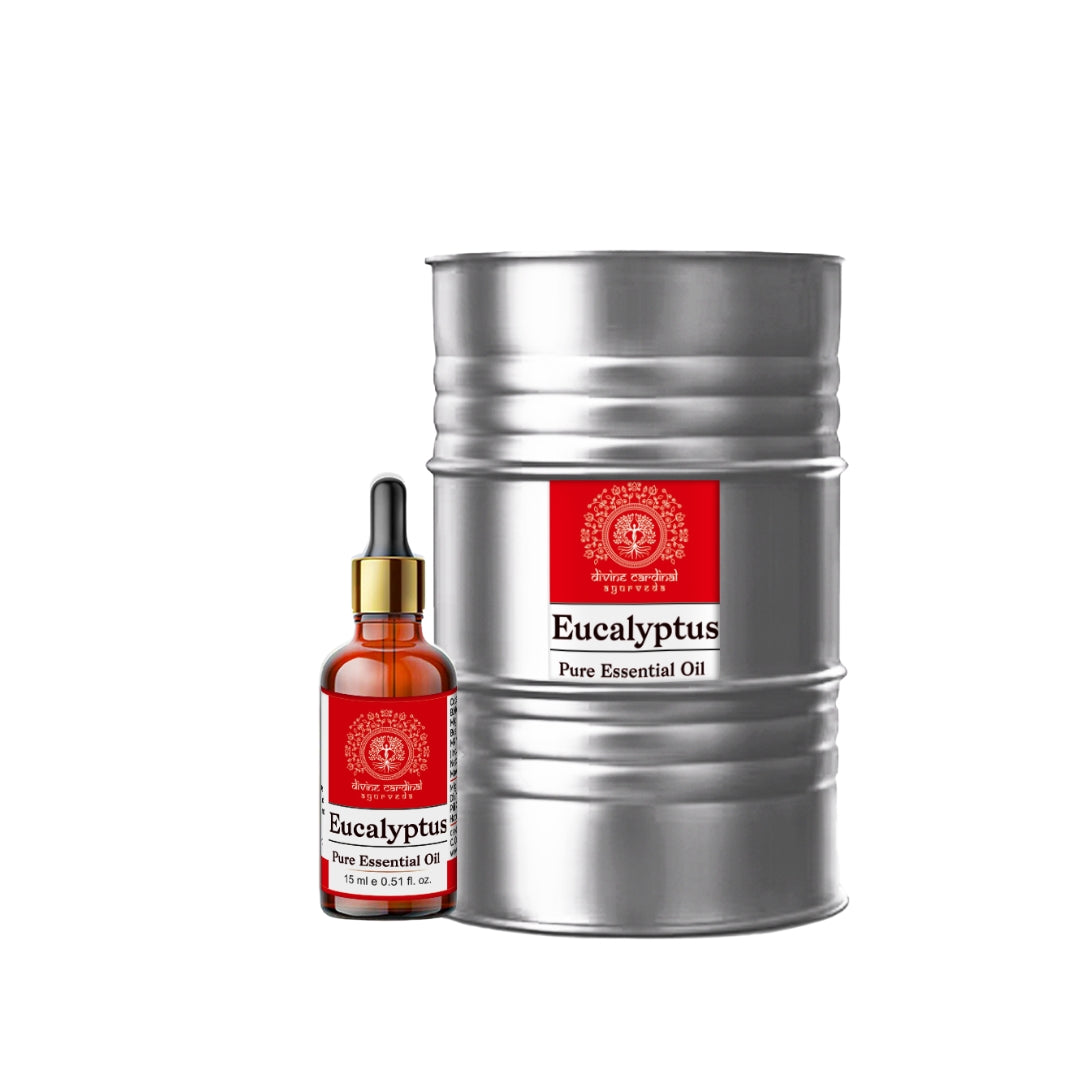
Therapeutic Grade Divine Cardinal Eucalyptus Globulus Pure Essential Oil – bottle with dropper and bulk container

SKU: DCI-PEO-0018  |  FEMA: 2466  |  CAS: 8000-48-4

Pure Essential Oils

Eucalyptus Oil

Eucalyptus globulus

A 100% pure, steam-distilled essential oil obtained from the fresh leaves and twigs of Eucalyptus globulus. Revered since the 1850s for its powerful respiratory, antimicrobial, and analgesic properties, this thin, colorless to pale-yellow oil carries an unmistakably intense, fresh, camphorous, woody aroma — the hallmark of pharmaceutical-grade eucalyptus.

Botanical Name
Eucalyptus globulus Labill.
CAS Number
8000-48-4
Extraction Method
Steam Distillation
Plant Part
Leaves & Twigs
Appearance
Colorless to Pale Yellow
Origin
India

Full Ingredient Specifications

Product Name
Eucalyptus Oil
Product Category
Pure Essential Oils
SKU / Product Code
DCI-PEO-0018
Botanical / INCI Name
Eucalyptus globulus Leaf Oil
Common Names
Eucalyptus globulus oil, Eucalyptus globulus leaf oil, Blue Gum Oil, Tasmanian Blue Gum Oil
CAS Number
FEMA Number
2466
EC / EINECS Number
232-527-5
Plant Family
Myrtaceae
Plant Parts Used
Fresh leaves and twigs
Extraction Method
Steam Distillation
Origin / Country
India (native: Tasmania & New South Wales, Australia)
Physical Appearance
Thin, colorless to pale yellow mobile liquid
Aroma Profile
Intense, fresh, green, camphorous, woody
Key Active Constituent
1,8-Cineole (Eucalyptol) — 60–85%
Refractive Index
1.458 – 1.470 (20°C)
Specific Gravity
0.906 – 0.929 (25°C)
Optical Rotation
0° to +10°
Flash Point
49°C (120°F)
Shelf Life
2–3 years (stored in cool, dark conditions)
Regulatory / Compliance
Purity
100% Pure & Natural — No Additives, Fillers or Diluents

History & Origin

1792
Eucalyptus globulus first recorded in Tasmania by explorer Labillardière.
1852
First commercial steam distillation of eucalyptus oil in Australia by Joseph Bosisto.
1880s
Tasmanian Eucalyptus Oil Company — with its iconic platypus logo — becomes the world's most respected supplier.
1890s
Exported to South Africa; wood used for mine shaft construction, oil for medicinal use in the mines.
1900s+
Adopted globally in pharmacopoeias: British Pharmacopoeia, European Pharmacopoeia, and the WHO monograph.

Eucalyptus globulus — commonly known as the Tasmanian Blue Gum — is a fast-growing evergreen native to the islands and coastal regions of southern Australia. It was first formally recorded in Tasmania in 1792 and is credited among the tallest flowering plants on Earth, reaching heights above 90 metres. The species was formally described and named by the French botanist Jacques Labillardière after his participation in the Bruni d'Entrecasteaux expedition.

Commercial distillation of the oil began in Victoria, Australia around 1852, driven in large part by the pharmacist and naturalist Joseph Bosisto, who pioneered the essential oil industry in Australia. The medicinal value of the oil — particularly its powerful antiseptic and respiratory-clearing qualities — was quickly embraced by physicians in the nineteenth century. By the turn of the twentieth century, eucalyptus oil was a fixture of colonial medicine chests from India to South Africa.

The tree's remarkable ability to absorb vast quantities of groundwater made it a strategic tool in swamp drainage programs throughout the Mediterranean basin, reducing the standing water that sustained malaria-carrying mosquitoes. This dual utility — agricultural land reclamation and medicinal resource — drove widespread global cultivation across Spain, Portugal, California, India, and the African continent.

Today, Eucalyptus globulus is cultivated commercially across India, China, Portugal, Spain, South Africa, and Brazil. India has emerged as one of the significant producers, with large-scale plantation forestry enabling consistent supply of high-purity steam-distilled oil meeting international pharmacopoeia standards. For further botanical context, see the Royal Botanic Gardens Kew profile and the CABI Invasive Species Compendium entry.

Therapeutic Properties

🫁
Expectorant & Respiratory
1,8-Cineole (eucalyptol) is clinically documented as a mucolytic agent that reduces airway mucus hypersecretion and improves mucociliary clearance. Extensively used in bronchitis, sinusitis, and upper respiratory infections. See PubMed – Cineole in respiratory disease.
🦠
Antibacterial & Antimicrobial
Demonstrated inhibitory activity against a broad spectrum of bacteria including Staphylococcus aureus, E. coli, and Pseudomonas aeruginosa. Research published in the Journal of Applied Microbiology supports its use as a natural biocide.
🔥
Anti-inflammatory & Analgesic
Cineole inhibits the arachidonic acid cascade, reducing prostaglandin production. Topical application provides meaningful relief in rheumatic complaints, arthritic joints, and muscular pain. Referenced in the EMA Herbal Monograph on Eucalyptus.
🌡️
Febrifuge (Fever-Reducing)
Long used in traditional medicine as a febrifuge — an agent that reduces fever. The diaphoretic action promotes perspiration and assists in temperature regulation during febrile illness. Referenced in the WHO Monographs on Selected Medicinal Plants.
🛡️
Antiviral & Antiseptic
Studies indicate inhibitory activity against enveloped viruses including influenza strains. High cineole content provides potent surface antiseptic action — well-established in hospital and pharmaceutical disinfectant formulations. See Antiviral Research – essential oils.
🌿
Antifungal & Antiparasitic
Exhibits antifungal activity against Candida albicans and dermatophytes. The anthelmintic property assists in clearing intestinal parasites. Relevant for both topical skin infections and broader infectious disease protocols. Details in Phytomedicine – essential oil antifungal review.

Therapeutic Indications

Respiratory infection & bronchitis
Sinusitis & catarrh
Infectious disease management
Fever (febrifuge application)
Muscular aches & pains
Rheumatism & arthritis
Urinary infection
Cystitis
Parasitic infection (anthelmintic)
Skin infections & wounds (antiseptic)
Head lice (pediculicidal)
Mental fatigue & concentration (inhalation)

Applications by Industry

Industry Application Key Properties Utilised
Pharmaceuticals Cough syrups, lozenges, inhalants, nasal sprays, topical analgesic rubs, dental antiseptics ExpectorantAntisepticAnalgesic
Aromatherapy Steam inhalation blends, diffuser oils, massage blends for respiratory & muscular care DecongestantAnti-inflammatoryStimulant
Personal Care / Cosmetics Shampoos, scalp treatments, foot creams, muscle balms, cleansers, acne treatments AntimicrobialAntifungalAntiseptic
Household Cleaning Disinfectant sprays, laundry additives, mould removers, multi-surface cleaners AntibacterialAntiviralAntiputrescent
Flavour & Fragrance Mint/menthol-family flavours, tobacco flavouring, industrial perfumery, chewing gums FEMA 2466Camphorous note
Veterinary Wound sprays for livestock, fly/insect repellent formulations, hoof care products AntisepticInsect repellentAntifungal

Chemical Profile

Primary Constituents

The dominant constituent of Eucalyptus globulus oil is 1,8-Cineole (Eucalyptol), typically comprising 60–85% of the total oil composition. This monoterpene oxide is responsible for the majority of the oil's pharmacological activities and is listed in multiple national pharmacopoeias as a defined quality marker.

  • 1,8-Cineole (Eucalyptol): 60–85% — expectorant, anti-inflammatory, antimicrobial
  • α-Pinene: 9–15% — antiseptic, anti-inflammatory
  • Limonene: 1–5% — antioxidant, mood-lifting
  • p-Cymene: 1–4% — analgesic, antibacterial
  • γ-Terpinene: trace — antioxidant
  • Aromadendrene: trace — wound healing

Reference: PubChem CID – Eucalyptus Oil · NIST WebBook

Quality & Standards

Divine Cardinal's Eucalyptus Oil conforms to the quality parameters outlined in globally recognised standards, ensuring pharmaceutical and cosmetic grade purity:

Safety & Precautions

⚠️
Important Safety Guidance

Pregnancy & Breastfeeding: Eucalyptus globulus oil should be avoided during pregnancy and while breastfeeding. For seniors and those in convalescence, Eucalyptus radiata is generally considered preferable due to its gentler composition.

Children: Do not apply eucalyptus globulus oil to the face or near the nose of children under 2 years. High cineole concentrations can trigger a reflexive cessation of breathing (seizure-like response) in infants. Always dilute appropriately before topical use on children.

Dermal Use: Dilute to a maximum of 20% in a carrier oil for topical application. Avoid contact with eyes and mucous membranes. Conduct a patch test prior to widespread use. See IFRA Standards for maximum usage levels by product category.

Drug Interactions: 1,8-Cineole may interact with the cytochrome P450 enzyme system. Consult a qualified practitioner before therapeutic use alongside medication. Refer to the NCCIH Eucalyptus Fact Sheet for further guidance.

Note: This information is provided for educational and professional reference purposes. It is not intended as medical advice.

External References & High-Authority Links

Blending & Compatibility

Recommended Blending Oils

Eucalyptus Globulus oil blends harmoniously with a wide range of essential oils, particularly those sharing fresh, clean, or medicinal aromatic profiles:

  • Peppermint — cooling respiratory synergy
  • Lavender — softens the camphorous intensity; calming
  • Tea Tree — amplified antimicrobial action
  • Rosemary — cognitive clarity, respiratory support
  • Lemon — brightens aroma; antiviral synergy
  • Pine / Fir Needle — deep forest respiratory blend
  • Thyme — powerful antibacterial synergy

Usage Dilution Guidelines

Following best practices from the National Association for Holistic Aromatherapy (NAHA):

  • Diffusion: 3–5 drops per 100ml water in an ultrasonic diffuser
  • Steam Inhalation: 2–4 drops in a bowl of hot water; inhale 5–10 min
  • Massage (Adults): 2–2.5% dilution (10–12 drops per 30ml carrier)
  • Topical Chest Rub: 5–10% dilution in a thick carrier oil or balm base
  • Bath: 5–8 drops mixed with an emulsifier before adding to bathwater
  • Cleaning Spray: 20–30 drops per 500ml water + alcohol base
B2B Wholesale & Bulk Supply

Interested in Bulk Purchase?

Divine Cardinal International supplies pharmaceutical, cosmetic, flavour & fragrance, and B2B manufacturers with high-purity, GC-MS verified Eucalyptus Globulus Essential Oil. Custom packaging, documentation (COA, MSDS, GC-MS reports), and global shipping available.

Write to Us